Showing posts with label Telecommunication. Show all posts

Wednesday, December 8, 2010

What is the Difference Between GSM and CDMA?


One of the basic things that differentiates GSM (based on TDMA) and CDMA is the way the carve up bandwidth.
Each bit of radio spectrum used by a handset has to be shared with other people in the area. It is more or less the same as multiplexing for normal data land lines.
The major difference between GSM/TDMA and CDMA is in the way they divide up those signals between multiple users.

Friday, December 3, 2010

What is EDGE?


Enhanced Data rates for GSM Evolution (EDGE) (also known as Enhanced GPRS (EGPRS), or IMT Single Carrier (IMT-SC), or Enhanced Data rates for Global Evolution) is a digital mobile phone backward-compatible extension of GSM. EDGE is considered a 3G radio technology and is part of ITU's 3G definition. EDGE was deployed on GSM networks beginning in 2003 —

Wednesday, December 1, 2010

What is GPRS?


Short for General Packet Radio Service, a standard for wireless communications which runs at speeds up to 115 kilobits per second, compared with current GSM (Global System for Mobile Communications) systems' 9.6 kilobits.

Saturday, November 27, 2010

What is 3G Technology?

If you want augmented bandwidth, multiple mobile applications and clarity of digital signals, then 3G (Thrid Generation Technology) is your gateway. GSM technology was able to transfer circuit switched data over the network. The use of 3G technology is also able to transmit packet switch data efficiently at better and increased bandwidth. 3G mobile technologies proffers more advanced services to mobile users. It can help many multimedia services to function. The spectral efficiency of 3G technology is better than 2G technologies. Spectral efficiency is the measurement of rate of information transfer over any communication system. 3G is also known as IMT-2000.

Tuesday, November 23, 2010

GSM Call Routing

Call Originating from MS.
Call Termination to MS.

Saturday, November 13, 2010

GSM Operations

The operation of the GSM system can be understood by studying the sequence of events that takes place when a call is initiated from the Mobile Station.

Call from Mobile Phone to PSTN:

When a mobile subscriber makes a call to a PSTN telephone subscriber, the following sequence of events takes place:

Friday, November 12, 2010

GSM Specifications

GSM 900


Mobile to BTS (uplink): 890-915 Mhz.
BTS to Mobile(downlink): 935-960 Mhz.
Bandwidth : 2* 25 Mhz.
GSM 1800
Mobile to BTS (uplink): 1710-1785 Mhz.
BTS to Mobile(downlink): 1805-1880 Mhz.
Bandwidth : 2* 75 Mhz.

* Carrier Separation : 200 Khz.
* Duplex Distance : 45 Mhz.
* No. of RF carriers : 124.
* Access Method : TDMA/FDD.
* Modulation Method : GMSK.
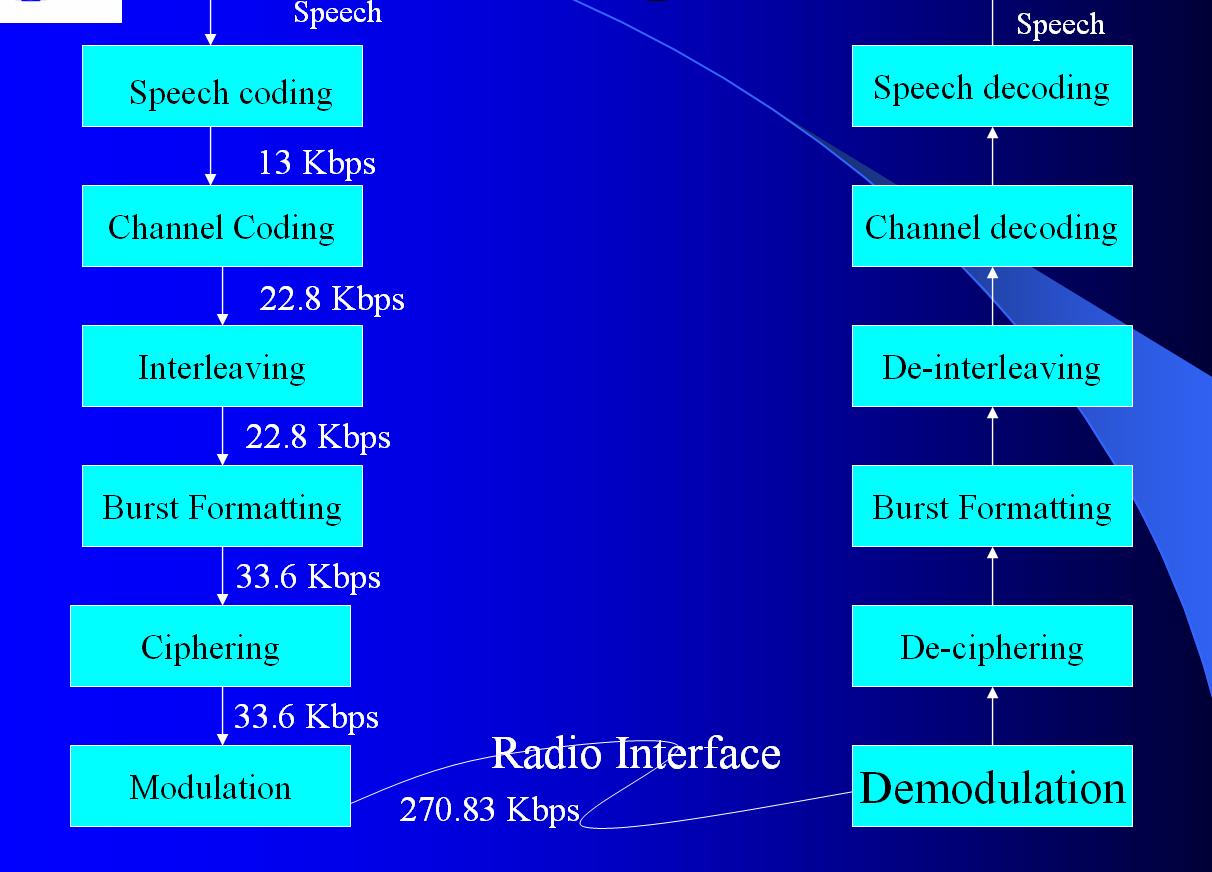
* Modulation data rate : 270.833 Kbps.

Thursday, November 11, 2010

Microwave Engineering Considerations

Free Space & Atmospheric Attenuation:

Free space & atmospheric attenuation is defined by the loss the signal undergoes traveling through the atmosphere.
Changes in air density and absorption by atmospheric particles.
Reflections:
Reflections can occur as the microwave signal traverses a body of water or fog bank; cause multipath conditions.

Microwave Impairments

  1. Equipment, antenna, and waveguide failures.
  2. Fading and distortion from multi path reflections.
  3. Absorption from rain, fog, and other atmospheric conditions.
  4. Interference from other frequencies.

Wednesday, November 10, 2010

What is XPIC?

Cross Polarization Interference Cancellation (XPIC).

Microwave having XPIC capabilities effectively double the potential capacity of a Microwave Path.
It allows the assignment of the same frequency to both the vertical & horizontal Polarization on a Path.

Monday, November 8, 2010

Types of Microwave Links

Hot Standby:
A method of redundancy in which the primary and secondary (i.e., backup) systems run simultaneously. The data is mirrored to the secondary server in real time so that both systems contain identical information. 


Sunday, November 7, 2010

Line of Sight (LOS)

Electromagnetic transmission includes light emissions traveling in a straight line. The rays or waves may be diffracted, refracted, reflected, or absorbed by atmosphere and obstructions with material and generally cannot travel over the horizon or behind obstacles. Especially radio signals, like all electromagnetic radiation including light emissions, travel in straight lines. At low frequencies (below approximately 2 MHz or so) these signals travel as ground waves,

Saturday, November 6, 2010

Repeaters

A microwave repeater with antenna isolation comprises a first receiving antenna for receiving an input signal from a distant source.
An amplifier section for amplifying and modulating the input signal to produce an output signal.
A transmitting antenna coupled to the amplifier section and an isolation control means including a second receiving antenna for isolating the first receiving antenna from the transmitting antenna.
In one preferred embodiment, the second receiving antenna is aligned so as to match the gain and phase from the transmitting antenna to the first receiving antenna.
The isolation control means comprises a phase shifter coupled to the second receiving antenna; and a power combiner having inputs coupled to the first receiving antenna and the phase shifter and an output coupled to the amplifier section.
The power combiner receives the input signal from the first receiving antenna and a 1 SO phased shifted signal from the phase shifter.

Friday, November 5, 2010

Synchronous Digital Hierarchy (SDH)

Management is very inflexible in PDH, So SDH was developed.
Synchronous Digital Hierarchy (SDH) originates from Synchronous Optical Network (SONET) in the US.
It includes capabilities for bandwidth on demand and is also made up of multiples of E1.
STM-1 (155Mb/s) is 63 x E1, STM-4 (622Mb/s) is 4 x STM-1 and STM-16 (2.5Gb/s) is 4 x STM-4.

Thursday, November 4, 2010

Plesiochronous Digital Hierarchy (PDH)

The Plesiochronous Digital Hierarchy (PDH) is a technology used in telecommunication networks to transport large quantities of data over digital transport equipment such as fiber optic and microwave radio systems.
The term plesiochronous is derived from Greek plesio, meaning near, and chronos, time, and refers to the fact that PDH networks run in a state where different parts of the network are nearly, but not quite perfectly, synchronized.

What is E1

An E1 link operates over two separate sets of wires, usually twisted pair cable. A nominal 3 Volt peak signal is encoded with pulses using a method that avoids long periods without polarity changes. The line data rate is 2.048 Mbit/s (full duplex, i.e. 2.048 Mbit/s downstream and 2.048 Mbit/s upstream) which is split into 32 time slots, each being allocated 8 bits in turn. Thus each time slot sends and receives an 8-bit sample 8000 times per second (8 x 8000 x 32 = 2,048,000). This is ideal for voice telephone calls where the voice is sampled into an 8 bit number at that data rate and reconstructed at the other end. The time slots are numbered from 0 to 31.

Wednesday, November 3, 2010

E-carrier


In digital telecommunications, where a single physical wire pair can be used to carry many simultaneous voice conversations, worldwide standards have been created and deployed.
The European Conference of Postal and Telecommunications Administrations (CEPT) originally standardized the E-carrier system, which revised and improved the earlier American T-carrier technology, and this has now been adopted by the International Telecommunication Union Telecommunication Standardization Sector (ITU-T).

Microwave antenna alignment (Cont..)


Simplifying the Process:

We have laid the groundwork for establishing the Path Align-R™ test set as a viable and effective solution for the path alignment process. We will now describe how this process of aligning the microwave link is greatly simplified.

1. Review the Engineering Profile to determine the expected RSL (received signal level, or path loss)for the link under test (this should include the free space path loss and the gain of the antennas). Note that the loss exhibited by the installed cable or waveguide transmission lines are not included in this value because the Path Align-R™ test sets are connected directly to the antennas with a short coax cable with minimal insertion loss to impact the test.


Microwave antenna alignment (Cont)

Alternative Methods:

Traditionally, the radios that will be placed at each site are used to complete the task of optimizing the path.However, there are several reasons for not utilizing the radios to complete the process. The radios may not be available at the time the test has been scheduled or their reliability may be questionable, thus alternate methods are needed. Another possible reason the radios might not be able to be used is that the FCC permit shave not been granted, but the contractor needs to complete the path test on time to meet the customer’s requirements, or ahead of expected turbulent weather. In addition, if the anticipated path is questionable, a quick, cost effective, reliable method is needed to test the link, prior to the significant investment of constructing towers, purchasing radios and other expensive equipment and hardware, etc.

Tuesday, November 2, 2010

Microwave antenna alignment


Simplifying the Path Alignment of Microwave Communication Systems:
Wherever microwave links exist, the path between antennas has always required accurate antenna alignment. This process requires highly trained tower crews to physically align the antennas as well as ground technicians and sophisticated, expensive, and complex test equipment to monitor the results. The process of optimizing the transmission path of microwave communication systems is about to undergo a significant development in process, simplification and cost benefit without compromising performance or accuracy. The process can now be accomplished with the use of the Path Align-R™ , Models 2200–2241, ยต wave Antenna Path Alignment Test Sets from Pendulum Instruments, formally XL Microwave. Tower installation crews can now perform the entire alignment process themselves, up the tower, at the antenna,